
History Spotlight: Placenames in Columbus and Muscogee County (Part 1)

SOURCE: Placenames in Columbus and Muscogee County: Part One by Kenneth H. Thomas, Jr. Muscogiana Journal, Vol. 22, Fall 2011.
The origin of a placename is often shrouded in time, unless it can be attributed to a specific person or event. We know for example, the J. R. Allen Parkway was named in the 1970s for the then-Mayor who was killed in a plane crash. But how many people new to Columbus would know that? How would they learn the details?
Trends in the use of certain types of names for cities, for example, can be studied in books, most interestingly those of George R. Stewart such as his Names on the Land (1945). The United States saw a rash of places named for classical references in the early 19th century, such as Athens and Rome, Georgia, or those we tend to pronounce differently, such as Cairo, Vienna, and Seville.
Columbus and Muscogee were founded in the 1820s by many people who moved to this area having been well-established in other parts of Georgia. No doubt they brought their own ideas about their favorite places and probably used some of the same names with which they were familiar.
(Author Ken Thomas’ note: The best way to present a book on placenames would be to arrange them in alphabetical order with cross references where necessary. For this series, it seems best to go by themes. Those that have been suggested are roads, rivers, creeks, houses, plantations, suburbs, neighborhoods, and schools.)

The Theme: Suburbs or Villages in early Columbus and environs
Linwood
Today, this is best known as the name of the City of Columbus's oldest cemetery for white burials, established when the city was laid out in 1828. But we also know that the cemetery was not known officially as "Linwood Cemetery" until the city council met in late 1894 and decided that henceforth, the two city cemeteries for whites would be known as Linwood and Riverdale.
So where did the term "Linwood" come from? In 1856, the Enquirer published an article referencing the then three suburbs, Wynnton, Rose Hill, and Beallwood, and the newest one, "Linwood," stating that it began at the residence of Mrs. Hodges and went on to that of Mrs. Shepherd. This latter house was that of Mrs. Anne Elizabeth Shepherd, and after her death, her son Col. William S. Shepherd, who at his death in 1924 left it to be used as the orphan's home and to be renamed to honor his mother. While the organization is still in business under that name at another location, the Shepherd property later became the Bradley Center at 2000 16th Avenue. In the 1850 Census of Muscogee County, Mrs. Ann E. Shepherd is at household no. 187, and Mrs. Elizabeth Hodges at no. 212, both in the 8th District. That gives us the parameters of the area from the census. One notes that some of the landowners in "Rose Hill," were listed within that range of household numbers, showing that the villages overlapped presumably placing Linwood as being between "Rose Hill" and what today is the St. Elmo residential area. The article stated that "Linwood" included "some twenty families living in the village." Mrs. Hodges was the widow of Methodist Rev. Samuel K. Hodges, who died in 1840.

Hillhouse, home of Mrs. Anne Elizabeth Shepherd, located in Linwood. Postcard image.
Linwood "was named in honor of Mrs. Caroline Lee Hentz, whose last and great novel is called Linwood." They were quoting another Columbus paper, the Times and Sentinel, for that information. Mrs. Hentz's last novel was actually titled Ernest Linwood and was published in Boston in 1856, thus making 1856 a pretty firm date as to when Linwood would have first been used in Columbus, with the suburb/village being given the name within a few months of the appearance of her book. The newspaper had earlier announced its publication in the March 15 issue. Advertisements for the book appear in subsequent issues. Mrs. Hentz, who had lived in Columbus only a short time, had actually died earlier in 1856 at her son's home in Florida and her husband later that same year.
Mrs. Hentz and her husband, N. M. Hentz, born in France, and a professor of languages, were living with their children in 1850 in the City of Columbus at household no. 641. Her maiden name was Whiting. The family had previously lived in North Carolina and Ohio. More on her can be found in various earlier histories of Columbus.
The name Linwood today also exists for the main road, Linwood Boulevard, which runs from the south side of the cemetery to 13th Avenue, as well as Linwood Elementary School (1125 15th St., now the Stewart Community Home), and Linwood Baptist Church (1430 10th Avenue, now the New Linwood Baptist Church is there).

Beallwood
The 1856 article also substantiates the story found in some of Columbus's published histories as to the source for the name Beallwood as a "suburb" or area of town, and today preserved in the term "Beallwood Connector," the Beallwood Station U. S. Post Office (31904), and most notably Beallwood Baptist Church at 4650 Veterans Parkway but taking up an entire block east to Hamilton Road. Locally, the word is pronounced as if it were "Bellwood."
A quote from the article best describes this suburb: “There is also another village in embryo, about a mile beyond the one above named [Linwood], on the Hamilton road, commencing at the residence of R. M. Gunby, and C. S. Harrison, Esq., and extending over an area of a mile in circumference, within which, and in sight of each other, some ten or eleven families reside. They have a day school of 25 or 30 scholars [The Beallwood Institute] and a Sabbath school has recently been started under very favorable auspices. The name of this pleasant little settlement is Beallwood, in honor of three ladies now residing there, each of whose surname before marriage was Beall. Prosperity to the city of Columbus, health and happiness to her suburban retreats.”

The last remaining historic house that made up the core of "Beallwood" was that of Robert M. Gunby which was recorded in 1934 by the Historic American Buildings Survey. Owned later by the Blackmon family, and by 1952, Jack T. Lester, the house, located at 4500 Hamilton Road, survived into recent times. Despite preservation efforts it could not be saved and was demolished ca. 1995-1996. It was located where Golden Corral is today.
While the article does not tell us more about these ladies, we know from the various histories of Columbus by Telfair (1929) and Worsley (1951), and a family history of the Beall family, as well as biographical sketches of two of the three spouses, who the three couples were: Dr. Henry Lockhart and wife Mary Ann Beall, Robert Mills Gunby and wife Jane Louisa Beall, and William Henry Young and wife Ellen Augusta Beall.
The Beall sisters came from Warren County, Georgia, to Columbus at various times. With the arrival of W. H. Young and family in 1855 from Apalachicola, Florida, by all accounts, including his obituary, that was when the settlement of Beallwood actually got underway. It is only after 1855 and this 1856 article, do you start to see references in the Columbus newspapers about Beallwood, including the deaths of various people, including Young's son, Robert A. Young in 1857. People are stated to be living, dying, and marrying "in Beallwood" or "at Beallwood." There is nothing indicating that Beallwood was the actual name of any one house, even though some people may think that was the case.

The home of William H. Young (pictured above) is pictured in Worsley's history, and the newspaper has an account of its burning in August 1896. In this article, the house is referred to as being "in Beallwood." A later house built on or near the same spot was by 1951 owned by Dr. A. C. Hobbs, at 4641 Hamilton Road. This location today would be a block north of the Beallwood Baptist Church (former street address 4519), both on the west side of Hamilton Road. A Georgia Historical Marker honoring William H. Young is located nearby on Hamilton Road, at a shopping plaza just north of 47th Street.

Fendall Hall, above, was built by William H. Young's brother - Edward. It is located in Eufaula, Alabama and is identical to William's home.
Rose Hill
The 1856 article clearly shows that the term "Rose Hill" was already in use for an area of what is now the city of Columbus, but at that time was of course not in the city limits, which went no further than the northern boundary of the city cemetery. The 1856 article does not give any description of Rose Hill. Below we will discuss how Rose Hill became part of the City of Columbus, and later on in discussing the Cook family, who owned Rosemont and Belmont, will discuss how Rose Hill got its name. Rose Hill, even in 1856, would have had only a few residents on the estates and even by 1886, as the map shows, was not yet a major residential area.

Rose Hill appears in the online newspapers, as a searchable item after the Civil War, as a location where various people lived, not as anyone's particular house. Mrs. Laura B. Comer is mentioned there in 1878, and by the 1880s, people are said to be living "on Rose Hill" and in 1883 the Chappell family are quoted as selling lots "on Rose Hill." It appears to have been in use before the Civil War, just not easily findable in the newspapers. A biographical sketch of Grigsby E. Thomas, Jr. (1842-1903), a noted lawyer, published in 1889, indicated that he was born in the Thomas family home "on Rose Hill" in 1842, although the area, as shown later, could not have had that name earlier than 1844. The sketch also stated that he still resided in the family home described as "on Rose Hill, one hundred feet higher than other portions of the city of Columbus, and from its summit, a beautiful view is obtained of the Queen City of the Chattahoochee..." When addresses were established, the house was located at 2015 6th Avenue (also known as Thomas Avenue for a few years) and is illustrated not only in the 1889 sketch, but earlier on the 1886 map, as well as in various books and on a postcard. Around 1914, a postcard shows the house occupied by Dr. J. H. McDuffie, Sr., as the McDuffie-Munroe Sanatorium, a hospital. By 1942, it had become the Oaklawn Chapel for L H. Averitt and was featured with a photograph and a full-page advertisement in the 1952 city directory as "Columbus' Largest and Most Modern Mortuary and Funeral Chapel." By 1954 it was the Shady Lane Inn boarding house owned by Mr. and Mrs. Grady H. Mullins. The house was listed as "vacant" in the city directories from 1955 through 1960 and by 1962 the address no longer appeared.
In 1886, the situation on Rose Hill changed with the creation of the Rose Hill Improvement Company and the news that they had filed for a charter to sell real estate on Rose Hill. In the issue of August 15, 1886, there was even talk that it would petition to be a separate town, and there were efforts underway to incorporate it, as the city of Columbus did not want to annex it then. Another article about the 1886 Bird's Eye View map of Columbus by Wellge, stressed the great bluff at Rose Hill. The map illustrates some of the houses then at Rose Hill, as well as the landscaping, and Rose Hill Park, which was located in the area east of the Grigsby E. Thomas house, and now is the area between 6th Avenue, Hamilton Road, and between 21st and 23rd Streets. The Rose Hill Methodist Church now sits on part of what was the park. Also shown is a roller-skating rink across from the park and in front of "Rosemont," the former Cook home.
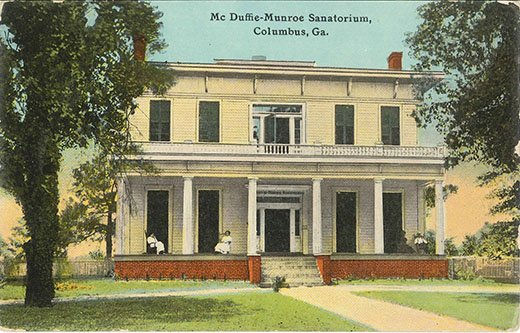
Postcard of the McDuffie-Monroe Sanatorium, formerly the home of
Judge Grigsby E. Thomas.
The charter for the Rose Hill Improvement Company was granted in early 1887. The newspapers for early 1887 indicate disputes over whether to add Rose Hill to the city, and apparently a vote was taken locally in March. Despite the ups and downs, Rose Hill shortly thereafter did get incorporated into the city of Columbus. An Act of the Georgia General Assembly was passed, and later signed by the governor on September 2, 1887, requiring a vote by the citizens of Rose Hill and Columbus. A later act clarified the boundaries of the Rose Hill Annex, effective July 26, 1889, stating that the northern line of the annex to also be the north line (city limits) of the City of Columbus east to the east side of Twelfth Avenue which will be the east line of the annex, and the southern boundary would be the former northern boundary of the city, Cemetery Street sometimes called Linwood Drive. Essentially the Rose Hill Annex to the city ran one mile north of the original city limits to present-day 29th Street, as the later city directories listed addresses only that far.


A well-explained article with useful insights into modern application development. Choosing the right serverless application development company can also help businesses build scalable and flexible solutions.
I am passionate about learning modern technologies like DevOps. DevOps is a powerful approach that combines development and operations to improve collaboration, speed, and software quality. It focuses on automation, continuous integration, continuous delivery, and monitoring throughout the development lifecycle. Learning through a DevOps Course in Bangalore helps professionals understand the tools, processes, and best practices required to build, test, and deploy reliable applications efficiently.
I am swathi, a passionate learner with a strong interest in data analytics and business intelligence. I have a good understanding of Power BI, a powerful tool developed by Microsoft for data visualization and analysis. I enjoy working with data, creating interactive dashboards, and generating insights that support decision-making. By pursuing a Power BI Course in Hosur, I aim to enhance my technical skills and build a successful career in data analytics, helping organizations make smart, data-driven decisions.
For graduates looking to build stronger technical skills, an MCA can provide deeper exposure to programming, databases, Online MCA Admission software development and emerging technologies. The online learning format can also be useful for professionals who want to continue their work while developing their IT knowledge and exploring areas such as AI, cloud computing and data analytics.
Wellness routines today seem to focus more on consistency and balance rather than occasional breaks. Simple practices that support relaxation can often help people feel more comfortable during demanding schedules. Discussions around Body Massage In Velachery reflect this shift, especially among those searching for spaces that allow the body to slow down naturally. Le Bliss Spa is one of the names that often appears when people talk about calm surroundings and steady wellness experiences.