
History Spotlight: The Origins of Fort Benning (Part 1 of 2)
- Historic Columbus
- Jul 15
- 9 min read

Part one is the story behind the development of a school for the infantry from the American Revolution to the establishment of Camp Benning in 1918. Dr. White shares the insight on how it all happened. Part two will conclude with the selection of the Bussey property and Columbus' involvement in the process.
SOURCE: The Origins of Fort Benning by Charles E. White, Ph.D. Command Historian, U.S. Army Infantry Center and School Ft. Benning, Georgia. Muscogiana Journal, 1995.
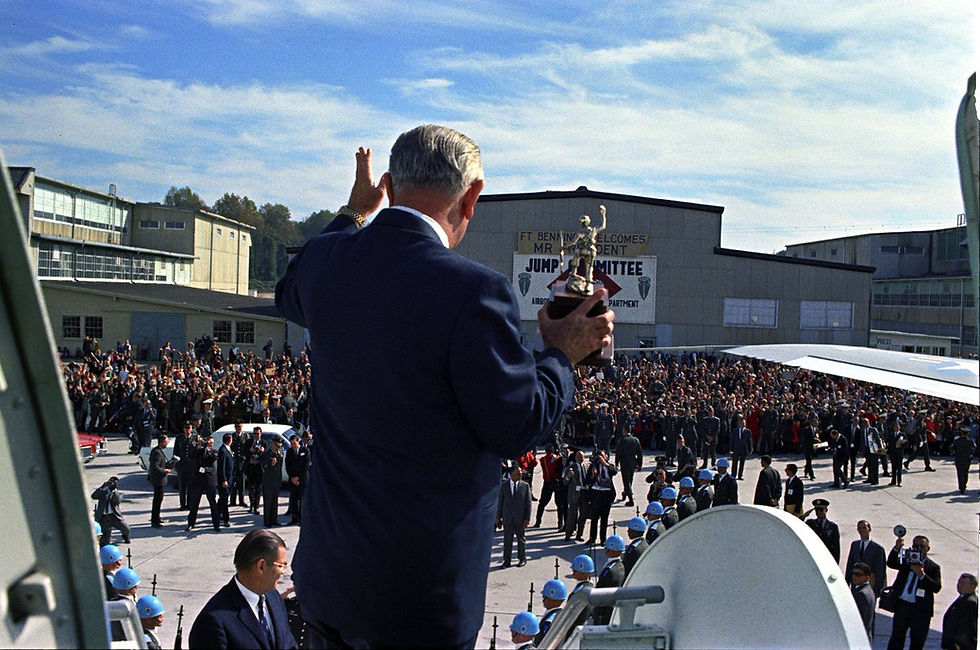
In his 1967 Veteran's Day speech at Fort Benning, President Lyndon Johnson called the Infantry Center "a cradle, ... a college, and a crossroads," and remarked that Fort Benning stood "at the beginning" of so much history. Indeed, the establishment of Camp Benning in 1918 signaled the end of one era of American history and the beginning of another.
A year earlier in 1917, the United States had cast aside Washington's advice to stay out of European affairs and entered World War I on the side of the Allied Powers (Great Britain, France, Italy, and Russia). For the first time in our history, the entire nation mobilized for war. Suddenly, America found herself totally unprepared for such an endeavor. In fact, in 1917 there was no Infantry Training Center in the United States. There was a School for Cavalry at Fort Riley, Kansas, and a School for Artillery at Fort Sill, Oklahoma, but no School for Infantry. This seems incredible given the majority of the army was infantry.
Today, after the experiences of two world wars, few would question the need for a "School for Infantry." But in 1917 few understood the need for such an institution. This stemmed in part from a traditional fear of standing armies, but perhaps more from the inflated reputation of the so-called "citizen soldier." I will trace the historic roots of Fort Benning, focusing primarily on the "crossroads" President Johnson spoke of, so that we can see why the establishment of an Infantry Center, here in 1918, was so crucial to our country's military preparedness, and was thus a major turning point in American history.
During the Revolutionary War, General George Washington continually found the Continental Army lacking the uniformity of drill, the similarity of organization, and the teamwork that would enable it to meet the British on the field of battle. To create a force capable of matching the British regulars required officers with some tactical skill and, perhaps even more important, officers and non-commissioned officers who could train their men in the school of the soldier. But finding and developing good leaders remained a source of constant frustration for Washington throughout the war. In a similar fashion, General John J. Perishing found the task facing him in 1917 equally depressing. As he later wrote: "I had been placed in command of a theoretical army which had yet to be constructed, equipped, trained, and sent abroad." But unlike Washington, Perishing had strong support in the Congress.
On 23 April 1917, Senator John W. Weeks from Massachusetts told his colleagues: When our men went to the border last year, a very considerable percentage — possibly as many as one-half — had never fired a rifle and nearly as large a proportion had never had an hour's drill. Weeks, who later served as Secretary of War under Presidents Harding and Coolidge, noted that America had never been prepared to fight a war. That Washington and Perishing fully understood this and knew what steps had to be taken to surmount the shortcomings of their respective military establishments, can be seen in the measures they took to mold their armies into effective fighting forces.

While encamped at Valley Forge during the winter of 1777, Washington instructed "Baron von Steuben" to give the Continental Army tactical training comparable to European standards. It was not long before Friedrich Wilheim von Steuben (pictured above) made his presence felt. One of his first acts was to organize the officer corps into an instructor cadre. He introduced them to a system of small unit tactics and drills and then dispatched them throughout the army to transmit what they learned. With the help of Alexander Hamilton, Steuben published a "Blue Book," as it was called, which prescribed drill regulations, tactics, and general military routine. Steuben then used the same technique, first to train non-commissioned officers (or sergeants), then the rest of the army.
General John J. Pershing's (pictured below) task 140 years later was equally formidable. The organized strength of the army on 1 April 1917 was 127,588 regulars, and 80,446 national guardsmen - a total of 208,034 officers and men. Before the war ended in November 1918, a year and a half later, the army would need 200,000 officers alone, and 4,000,000 men. How was Perishing to train these soldiers? Steuben's method would simply not work with such a massive military force. In fact, it had not really accomplished Washington's goal during the Revolution. That's because it takes considerable time to educate and train soldiers. Fortunately, America had the time in 1917 to train her army. But this was the exception, not the rule.

Throughout our history, the myth of militia prowess had hindered the establishment of an infantry training center. Nevertheless, there were a few enlightened soldiers who had argued the case for the Infantry. Following the Revolution, Washington, in his "Sentiments on a Peace Establishment" (1783), had urged Congress to create schools for the soldier, and particularly one for the officer corps. But it was not until 1802, ironically during the Jefferson Administration that Congress finally voted funding for a United States Military Academy at West Point, New York.
Still, there were no training centers for the troops. Enlistees reported to their respective regiments and there received a rudimentary training at best. Thus, when Congress declared war against Great Britain in 1812, the army was virtually as heterogeneous and disorganized as it had been when Steuben had begun his work at Valley Forge 35 years earlier. And in the early battles of the war, America paid the price for unpreparedness. Later, the regular force won several resounding victories, but most Americans chose to remember its early disasters and Andrew Jackson's stunning victory at New Orleans instead. In the eyes of many, the citizen-soldier at New Orleans had performed just as well as the professionals at Chippewa. Fortunately, Congress knew better. It had had to evacuate the capital in 1814, and that memory helped to secure increased funding following the war.
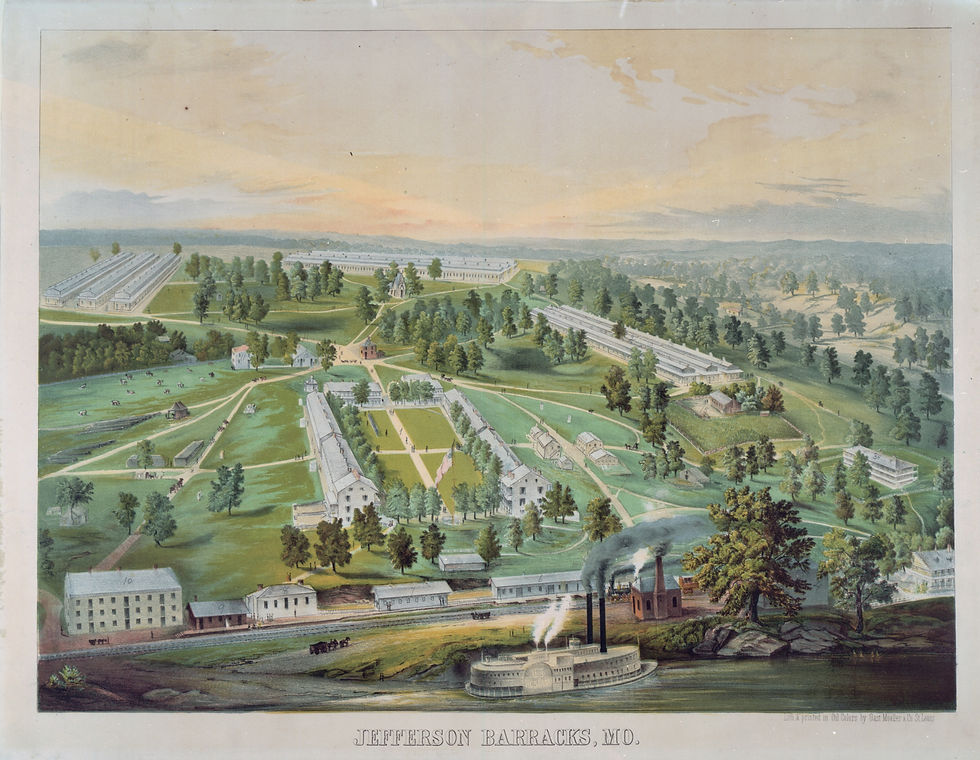
In 1826, Major General Edmund P. Gaines, after a long and patient effort, persuaded the War Department to authorize the establishment of an "Infantry Post" at St. Louis, for the purpose of organizing an "Infantry School of Instruction." Jefferson Barracks in St. Louis thus became the Infantry's first school. The bulk of the army's infantry was assembled there in 1826 and 1827. Though the idea of the school had initially been to train enlisted men, thereby ensuring some measure of standardization within the army, the plan was quickly expanded to include officers. Soon, the principal function of the school was to educate and train officers. Unfortunately, as memories faded, so did congressional support. Within two years the War Department had changed its priorities, and the regiments stationed at St. Louis were dispersed one by one to Minnesota, the Missouri Valley, and even Maine to ward off any danger to the settlements there. By the fall 1828 the school had ceased to function, on 24 November that year it was officially closed.
However "primitive" by today's standards it may appear, the Infantry School of Instruction at St. Louis was a great step forward in the advancement of infantry training. It was the first concrete expression of Washington's idea of a permanent school to teach the tactics and techniques of the infantry. Although its existence was only temporary, enlightened soldiers recognized the school's worth. Even some of its original skeptics acknowledged its value in their report to the Secretary of War. Still, the need for well-trained infantry soldiers was not fully perceived in the Army or accepted by the nation. Elation and overconfidence from having defeated the British in two wars, and success in having driven the Native Americans steadily westward, led most Americans to doubt the need for a well-trained infantry force. Our country was growing fast, and its sense of "Manifest Destiny" occupied the minds of the people, who were not overly concerned with military preparedness. Nevertheless, a few enlightened soldiers continued their quest for military schools in the United States.

United States Infantry and Cavalry School, 1893-1895 class photo.
Following the Civil War, William Tecumseh Sherman became the architect of a new kind of professionalism in the Army. During his tenure as Commanding General of the Army, from 1869 to 1883, Sherman established a system of post graduate schools through which an officer could not only learn the skills of his particular branch of the service, but also the functions of higher command. Schools of Instruction were established for the engineers, the artillery, the signal, and the medical corps. In 1881, Sherman founded a School of Application for the Infantry and Cavalry at Fort Leavenworth to educate selected officers in the art of high command. Finally, 1892, the Army established a separate school for the cavalry, but no such school for the infantry.
As one contemporary put it: "Perfection in close order drill, individual marksmanship, the mechanical deployment and advance of linear skirmish lines, and a smattering knowledge of patrolling, were the main criteria of good infantry. Every cavalry and artillery officer felt himself equal to commanding infantry in battle but guarded the technique of his own branch as a secret which the infantry mind could not... penetrate."
Paradoxically, the noted Harvard social scientist, Samuel Huntington, wrote 75 years later in his book, The Soldier and the State, that the post-Civil War years were "the most fertile, creative, and formative in the history of the American armed forces." Nothing could be further from the truth. It took the Army over 100 years to recognize the importance of training and educating its soldiers. At best, these new schools lagged far behind the standards George Washington had once prescribed. The fiasco of the Spanish American War of 1898 clearly demonstrated this, but once again, most Americans chose to remember the charge of the so-called "Rough Riders" up San Juan Hill instead of the extent of our unpreparedness. Even against a third-rate power like Spain, the Army performed relatively poorly. What would happen against a first-rate power like Germany? Clearly, the post-Civil War years were not "the most fertile, creative, and formative in the history of the American armed forces."

After the Spanish-American War the Army underwent important organizational and administrative changes aimed in part at overcoming some of the most glaring defects revealed during the war. Although the nation had won the war with comparative ease, many enlightened soldiers and civilians realized that victory was attributable more to the incompetence of the enemy than to any special qualities displayed by the Army. Perhaps no one appreciated the need for reform more than Elihu Root (pictured above), a New York lawyer appointed Secretary of War in 1899 by President McKinley. Beginning in 1899, Root outlined in a series of masterful reports his proposals for fundamental reform of Army institutions and concepts in order to achieve that "efficiency" or organization and function required of armies in the "modern" world. Root concluded that the true purpose of any army must be "to prepare for war," and thus took prompt steps to reshape the American Army into an instrument of national power capable of coping with the requirements of modern warfare.
One of the most important changes that resulted from the "Root Reforms" was a thorough reorganization of the Army's educational system. The overall objective of the new program was to raise the standards of professional training for both officers and men. In 1901, the War Department directed the establishment of "schools of application" at each army post for the training of non-commissioned officers and men; "branch schools" for cavalry, artillery, engineer, signal, and medical officers; a General Staff and Service College to train selected officers in the employment of combined arms, and to prepare them for high-level command and staff positions; and finally, a War College for senior officers. But once again, the Army saw no need for an "Infantry" branch school. Nevertheless, one enlightened officer took independent steps to correct this deficiency.

On 21 February 1907, Lieutenant General Arthur MacArthur, father of Douglas MacArthur, established the "School of Musketry" at the Presidio of Monterey, California. Although the "official" mission of the school was to raise the marksmanship standards of the Pacific Division (at that time the Army was divided into territorial divisions, and MacArthur commanded the Pacific one), there can be little doubt that MacArthur intended to create an "Infantry School of Instruction" similar to the one at Jefferson Barracks, St. Louis, 80 years earlier. The curriculum, an ambitious one for those days, aimed at both the practical use of and more importantly, the theoretical study of the rifle, the revolver, and the machine gun. Officers, non-commissioned officers, and soldiers spent hours firing each of the weapons and studying their application on the battlefield.
Each class averaged approximately 8 officers and 75 enlisted men. By so structuring the curriculum to include the theory of arms, MacArthur legitimately included courses that taught the tactical deployment, maneuver, and logistical support of infantry units in battle. It was an ingenious concept. One of the most significant indications of the progressives of this school was its quick perception of the airplane as a menace to the infantry. This resulted in a series of experimental tests in 1911 using massed rifle and machine gun fire to shoot down box kites representing airplanes. The War Department soon recognized the value of the School of Musketry, and drafted plans to move it to a central location, where the entire Army could benefit from one man's courage and initiative. After six years at the Presidio, the School of Musketry was formally transferred to Fort Sill in 1913.
With the outbreak of the First World War in 1914 came the slow realization that America could no longer remain isolated from world affairs. In August 1917, just three months after America's declaration of war, the School of Musketry was officially changed to the "Infantry School of Arms," and its curriculum was expanded to include instruction in basic infantry skills. Each class now averaged 400 students, and it was soon apparent that Fort Sill, Oklahoma, was not adequate for the training of both the Infantry and the Artillery. President Wilson's able Secretary of War, Newton D. Baker (pictured below), directed the Army to begin a search to find the most suitable location for the new Infantry School of Arms.


A fascinating look at the early history of Fort Benning and the events that shaped its development. When preserving historical records and photographs, it can also be useful to clean scanned documents so older materials are clearer and easier to archive.
Trong lúc xem thêm một số nền tảng trực tuyến, mình tình cờ bắt gặp https://23winkd.com/ nên tò mò truy cập để xem qua. Mình không dành quá nhiều thời gian đọc sâu mà chủ yếu để ý cách họ phân chia các khu vực trên trang. Ấn tượng đầu tiên là bố cục khá thoáng, từng khối nội dung được tách biệt nên không tạo cảm giác quá nhiều thông tin cùng lúc. Khu vực nhận xét của người nổi tiếng cũng được bố trí riêng, đọc nhanh vẫn nắm được ý chính.
Tối qua lúc có chút thời gian rảnh, mình mở 789WIN.COM xem thử vài phút vì thấy website được nhắc đến khá nhiều. Mình chủ yếu quan sát cách họ bố trí trang chứ chưa định tìm hiểu sâu. Nhìn tổng thể, các khối nội dung được tách thành từng phần khá rõ, tiêu đề có kích thước nổi bật nên khi kéo xuống vẫn dễ biết mình đang ở khu vực nào. Trang phản hồi khá nhanh, menu dễ tìm và màu sắc nhìn hài hòa.
Great article. The instructions are clear, well organised, and easy to follow from beginning to end. I was searching for a dependable https://s666mvp.com/ , and this guide helped me download Pinterest content without any confusion. It's refreshing to find information that actually works as described. Keep up the excellent work.
Trong quá trình xem thêm các nền tảng trực tuyến, mình tình cờ biết đến https://tk888t.com/ nên đã truy cập để có thêm cảm nhận riêng. Mình tập trung vào cách website bố trí giao diện, phân loại nội dung và hỗ trợ người dùng khi truy cập bằng những thiết bị khác nhau. Trên điện thoại, website vẫn hiển thị rõ và thuận tiện để theo dõi. Đây là một trang có thiết kế thân thiện và phù hợp cho việc tham khảo nhanh.